
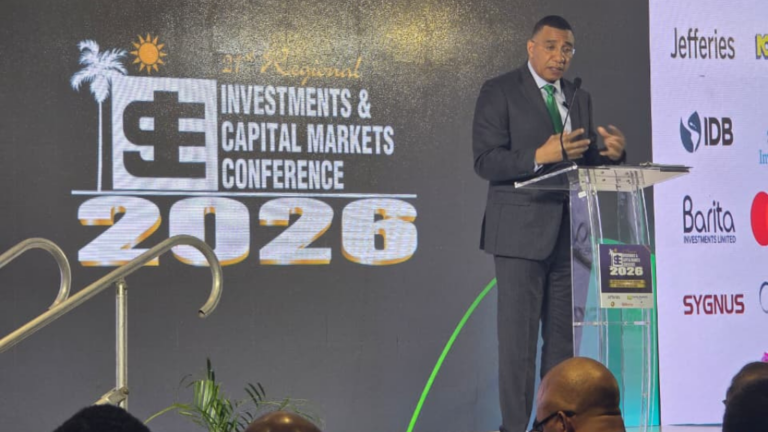
KINGSTON, Jamaica — Prime Minister Andrew Holness used a major investment forum this week to redraw the meaning of independence for modern Jamaica, arguing that sovereignty without economic strength is symbolic at best.
Speaking at the 21st Regional Investments and Capital Markets Conference at the Jamaica Pegasus Hotel, Holness said the country must move beyond celebrating political milestones and instead focus on building the financial muscle that makes true autonomy possible.
“Political independence without economic independence is incomplete,” he told delegates. “At some point, a nation has to be able to stand on its own balance sheet.”
Holness stressed that Jamaica’s future influence will not come from size or ideology, but from credibility, discipline, and the strategic use of economic leverage. According to him, even small states can exert global influence if they understand how to position themselves within modern geopolitical and financial systems.
He pointed to the government’s fiscal reforms and institutional strengthening as proof that Jamaica is now being taken seriously by international partners. Those changes, he said, helped the country mobilize billions in external financing in the wake of Hurricane Melissa — not as a handout, but as a signal of trust.
“The real win isn’t just the money,” Holness noted. “It’s the access to low-cost financing with minimal conditions. That only happens when the world believes you’re responsible and predictable.”
The prime minister also rejected the idea that economic development is only about large corporations or foreign investors. He framed small entrepreneurs as the backbone of national growth, highlighting everyday vendors and micro-business owners as the true face of Jamaica’s private sector.
“Our economy isn’t just banks and conglomerates,” he said. “It’s the woman frying fish on the roadside. She is just as much the private sector as any boardroom.”
Holness said policies must be judged by whether they expand opportunity at that grassroots level — enabling ordinary Jamaicans to earn, trade, educate their children, and live with dignity.
He closed by warning against what he described as past detours into ideological thinking that weakened the country’s economic footing. This administration, he said, intends to stay anchored in pragmatism, stability, and long-term national interest.
“Our political future depends on our economic strength,” Holness concluded. “And we are not going back to wandering in economic uncertainty again.”
