
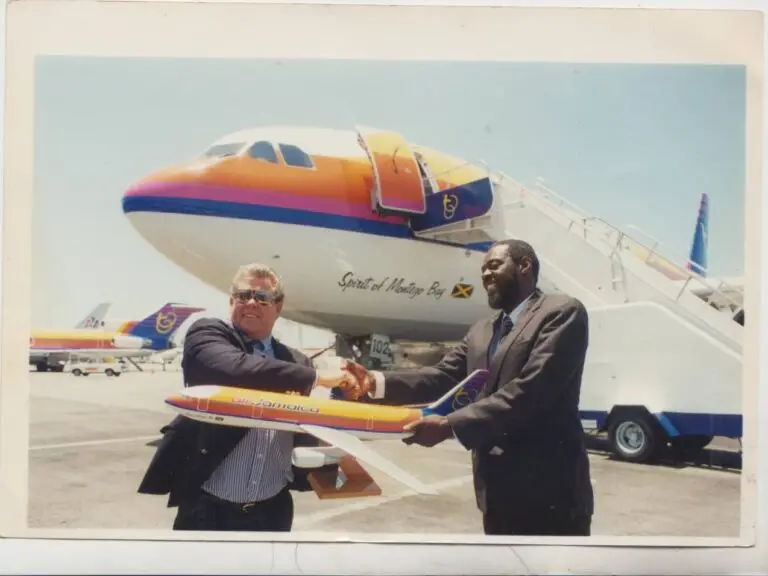
When Gordon “Butch” Stewart took control of Air Jamaica in 1994, he was not buying an airline.
He was buying an idea.
An idea that Jamaica could run something complex, capital-intensive, and internationally scrutinised — and win.
At the time, Air Jamaica was already a cultural icon. The “Love Bird” carried identity more than passengers. But behind the romance sat a fragile enterprise: ageing aircraft, politicised operations, porous security, weak capital, and a balance sheet quietly bleeding.
Stewart entered not as a financier hunting returns, but as a builder attempting resurrection.
And resurrection, in aviation, is unforgiving.
An Airline in Free Fall
By the early 1990s, Air Jamaica had become an airline with a loyal brand and a broken engine.
Security failures had turned it into a smuggler’s corridor. Free travel for political elites drained revenue. Financing for modern aircraft was absent. Privatisation attempts had collapsed. Operational discipline had eroded.
It was still loved — but love does not pay leasing costs.
When Stewart’s Air Jamaica Acquisition Group acquired controlling interest for US$26.5 million, the airline was less a business than a national liability.
The task was not to grow it.
It was to stop the collapse.
Rebuilding the Machine
Stewart moved with the instincts that had built Sandals: service, reliability, image, discipline.
He rebuilt the airline from the inside out.
Schedules were tightened. Queues attacked. Brand elevated. New aircraft ordered. Staff retrained. Pride restored.
Air Jamaica became visible again — punctual, professional, aspirational.
Routes expanded. Gateways multiplied. Alliances formed. Technology modernised. Heathrow was conquered.
Passenger volumes surged. Tourism arrivals rose. The airline became infrastructure, not transport — a spine for the national economy.
At its peak, more than half of visitors to Jamaica arrived on Air Jamaica metal.
For a moment, it worked.
The Invisible Enemy
Then came the blow that no marketing campaign could fix.
In 1995, the United States downgraded Jamaica’s aviation safety oversight to Category II.
Not Air Jamaica.
Jamaica.
But Air Jamaica paid the bill.
Flights restricted. Routes frozen. Aircraft idle. Leasing costs ballooned. Alliances delayed. Financing blocked. Reputation bruised.
The downgrade lasted more than two years.
The losses were catastrophic.
Over US$150 million evaporated — capital that should have built hubs, opened Europe and Asia, anchored Jamaica in global air corridors.
Instead, it financed survival.
Stewart later said it wiped out AJAG’s equity and strangled working capital.
The airline did not fail because it could not fly.
It failed because its country could not certify.
Growth Without Profit
Still, the airline expanded.
A Montego Bay hub stitched the Caribbean together. Utilisation climbed. Spanish hotel chains followed. Thousands of rooms were built. Regional connectivity finally existed.
The Love Bird became an engine.
An MIT study later estimated that between 1995 and 2004, Air Jamaica contributed more than US$5.4 billion to Jamaica’s economy through wages, procurement, and tourist inflows.
Direct and indirect.
Visible and invisible.
At the same time, the airline itself lost US$674 million.
A paradox only infrastructure can create: destroying shareholder capital while building national wealth.
The Final Storm
Then came September 11.
Global aviation collapsed overnight. American carriers filed for bankruptcy. Washington injected US$19 billion into its airlines.
Air Jamaica received nothing.
Tourism fell. Crime headlines rose. Insurance costs climbed. Financing dried.
Stewart now faced an asymmetry no patriot could bridge: a privately funded airline competing in a subsidised global battlefield, carrying a national brand, absorbing national failures, without national balance sheet protection.
At some point, empire survival outweighed national rescue.
In December 2004, he handed the airline back to the State.
Not in defeat.
In exhaustion.
The Quiet Extinction
Caribbean Airlines later absorbed Air Jamaica.
The livery disappeared.
The routes dissolved.
The phrase “little piece of Jamaica that flies” slipped into nostalgia.
But the deeper truth remains: Air Jamaica did not die because it lacked passengers, purpose, or patriotism.
It died because aviation is not romance.
It is capital, regulation, geopolitics, certification, and scale.
Stewart proved something rare.
That a Jamaican entrepreneur could rebuild a broken national institution, modernise it, integrate it into global networks, and turn it into economic infrastructure.
