
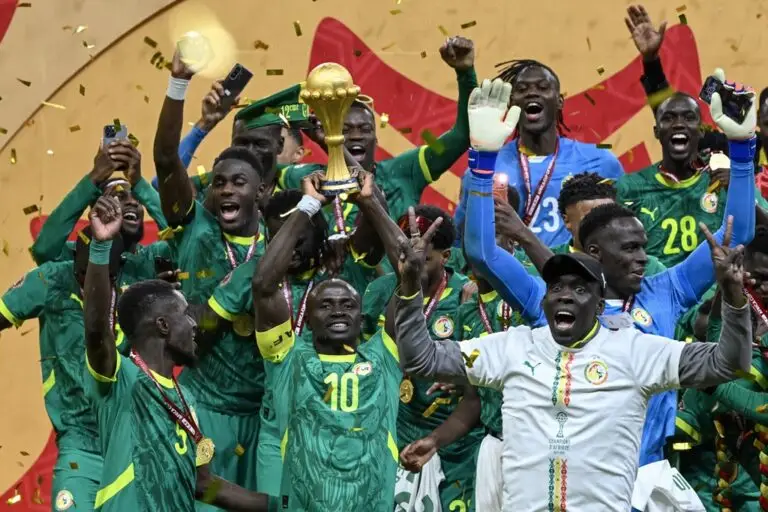
RABAT — Africa’s biggest stage delivered drama, disorder, and finally destiny.
Senegal claimed the Africa Cup of Nations with a ruthless 1–0 extra-time victory over hosts Morocco, sealing the trophy in a final that veered from controversy to violence before ending in heartbreak for the home crowd.
The turning point came late in normal time. With the match drifting toward extra time, referee Jean-Jacques Ndala awarded Morocco a penalty after a prolonged VAR review. The decision ignited fury on both benches and in the stands, halting play for nearly 20 minutes.
When order returned, Brahim Diaz stepped forward with the stadium holding its breath. His chipped attempt lacked conviction. Edouard Mendy read it calmly and gathered the ball, extinguishing Morocco’s clearest path to glory.
What followed was combustible.
Angered Senegal supporters hurled objects and attempted to breach the field before stewards and police restored control. Moments earlier, Senegal themselves had seen a stoppage-time goal ruled out, compounding the sense that the final was slipping into chaos.
Extra time arrived with the tension still unresolved.
Then came the strike.
Four minutes into the additional period, Sadio Mane disrupted play in midfield and released Idrissa Gana Gueye, who threaded a pass into space. Pape Gueye surged forward, held off Achraf Hakimi, and unleashed a precise finish beyond Yassine Bounou into the top corner.
Rabat fell silent.
Morocco pushed desperately for a reprieve. Nayef Aguerd rattled the crossbar. Chances flickered and died. But Senegal closed ranks and ran down the clock with discipline that champions are built on.
For the hosts, the defeat was brutal. A home final, a half-century wait, and a golden chance lost from twelve yards. Diaz, distraught, was withdrawn moments after his miss. Thousands filed out before the final whistle, unwilling to watch the ending.
For Senegal, history deepened.
This was their second AFCON title in three tournaments, confirming their status as Africa’s modern standard-bearers. Remarkably, it was the first goal they have ever scored in an AFCON final — and it proved enough.
They now turn their attention to the World Cup in the United States, hoping to convince Mane to delay his international farewell for one last continental campaign.
The night, however, will not be remembered only for football.
The post-match fallout is expected to focus on crowd conduct, team behaviour, and organisational failures after the scenes that marred the climax of Africa’s premier competition.
What should have been a celebration became a trial by fire.
And when the smoke cleared, Senegal stood alone with the crown.
