
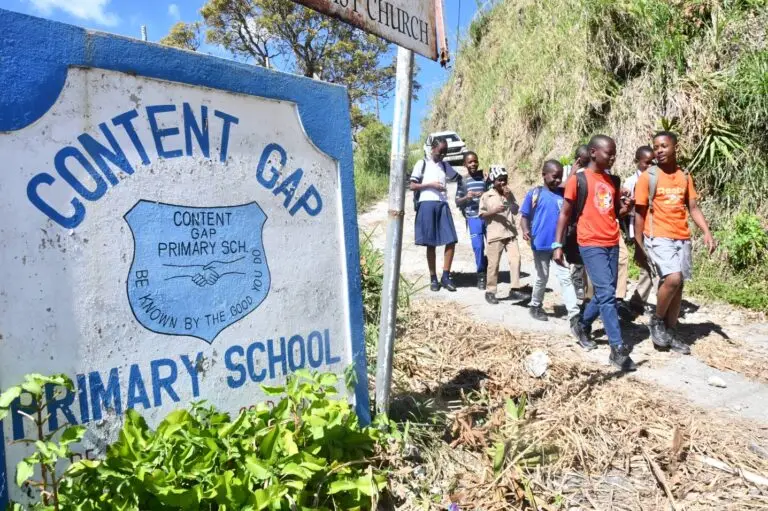
ST. ANDREW, JAMAICA — In the highlands of Content Gap, education has not taken a back seat, even as Hurricane Melissa left the rural district bruised and battling for recovery. With power lines down, water supply strained, and roads nearly impassable, the staff of Content Gap Primary School is waging a quiet war — not just against nature’s aftermath, but against disruption to their students’ futures.
At the helm, Principal Tanya Lynch Davis has transformed disaster into determination.
“This school isn’t just a building — it’s the center of this community’s life,” she said. “If it stops, everything stops.”
Adapting in Real Time
In the absence of electricity, the school’s clock has been reset. Instead of the usual full day, children now learn from 8:00 a.m. to 12:00 noon — a compromise between darkness and determination. As the classrooms dim by afternoon and kitchens fall silent without refrigeration, staff have cut lessons to preserve what little can still be delivered effectively.
Lynch Davis now lends her own solar light from home to brighten the darkest corners — a temporary fix, but one that speaks volumes. Her long-term vision? Solar panels. Not just as a contingency, but as a permanent guarantee that education doesn’t flicker with the national grid.
“If we had solar, we could power the classrooms, the kitchen — even run longer school hours,” she explained. “We’d stop being vulnerable.”
Resilience Starts With Clean-Up and Care
The school’s phased reopening began with a mop and a mission. On November 3, faculty and community members rolled up sleeves to clean debris and restore the grounds. A week later, staff met to assess readiness — not just physical, but emotional.
Then came the most human step of all: healing. With prayer, games, and open conversation, teachers and students held psychosocial sessions to process their experiences — some laughing through the memories, others simply glad to be together again.
“Before we could teach, we had to make sure everyone was mentally okay,” said Lynch Davis. “The trauma was fresh, and ignoring it would’ve been irresponsible.”
Barriers Beyond the Classroom
For some staff and students, the road to school is now a test of will. Teachers from Middleton now navigate river routes after the main road was washed away. Others have temporarily relocated just to continue showing up. Children from Lower David’s Hill and St Peter’s must balance across planks and ford rivers to make it in time for roll call.
Despite these obstacles, attendance is stabilizing — a testament to the school’s influence and the community’s commitment.
Unit tests for grades four through six are complete, and the school remains on track for upcoming national assessments. The principal credits this to foresight — many lessons were strategically front-loaded in September — and a staff culture built on shared leadership.
A Call to Action for the Sector
Lynch Davis believes that the real threat to education isn’t only natural disaster, but the institutional silence that often follows. From COVID-19 to Hurricane Melissa, she’s watched vulnerable students absorb the blows without adequate cushioning.
“Education is more than academics,” she said. “It’s mental, social, emotional. If we fail to protect the whole child, then we haven’t really educated them at all.”
She’s urging policymakers, schools, and communities to treat post-disaster recovery as a full-spectrum response — not just reopening doors, but rebuilding lives.
In the heart of a battered village, one school stands not because it was spared, but because it refused to sit still. Content Gap Primary isn’t just surviving — it’s setting the blueprint for how education endures.
