
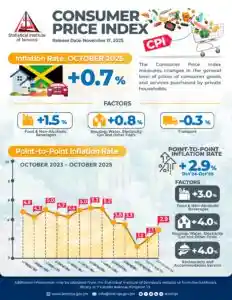
Jamaican consumers faced steeper living costs in October as inflation ticked up by 0.7%, driven largely by rising food and electricity prices. The latest figures from the Statistical Institute of Jamaica (STATIN) place the country’s annual inflation rate at 2.9%—still within manageable bounds, but revealing underlying cost pressures in key household categories.
Food prices remain the dominant inflationary force. The “Food and Non-Alcoholic Beverages” category surged 1.5% month-over-month, led by a sharp increase in the cost of vegetables, legumes, and ground provisions. Items such as carrots, cabbage, and sweet potatoes saw the steepest price hikes, with the overall group jumping 5.5% in October alone.
Utility costs also nudged upward, with the “Housing, Water, Electricity, Gas and Other Fuels” segment registering a 0.8% increase—primarily due to elevated electricity charges. These price movements further added pressure on household budgets already strained by food-related inflation.
Notably, some relief came from the transportation sector. The “Transport” division dipped by 0.3%, offering a minor offset to overall inflation thanks to lower petrol prices at the pump.
Looking at the broader 12-month trend, inflation has been primarily shaped by three areas:
- Food and Non-Alcoholic Beverages: +3.0%
- Housing, Water, Electricity, Gas and Other Fuels: +4.0%
- Restaurants and Accommodation Services: +4.0%
STATIN clarified that October’s price data was gathered during scheduled field visits in the first and third weeks of the month—before Hurricane Melissa swept through the island. As a result, the current inflation figures do not capture any price disruptions that may have occurred due to the storm’s aftermath.
The agency continues to serve as the authoritative body for tracking economic indicators across Jamaica, with its inflation metrics closely watched by policymakers, financial institutions, and business leaders assessing the economic climate. While inflation remains relatively subdued, the upward momentum in food and utility prices could warrant closer attention in the months ahead—especially if hurricane-related supply issues begin to feed into the data.
