
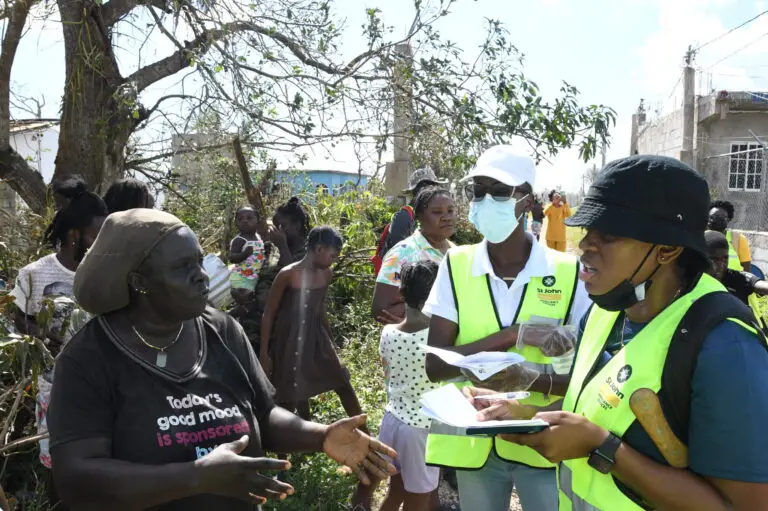
As floodwaters recede and the country slowly recovers from Hurricane Melissa’s wake, an unlikely force is leading the frontline response—ordinary citizens armed with compassion, skill, and resolve. Over the weekend, more than 250 volunteers, backed by national charities and mobilized under St John Ambulance Jamaica, fanned out across remote areas of St Elizabeth and Westmoreland, stepping into a void left by shattered roads, power outages, and overwhelmed systems.
Operating in villages where emergency services simply could not reach, volunteers provided essential medical attention to nearly 800 storm-struck residents. In areas cut off from communication, Wi-Fi was restored via Starlink routers, while transportation was powered by the logistics support of the Jamaica Automobile Association. This was not a corporate campaign. It was an intervention by people, for people.
The Faces Behind the Numbers
In Barton Wharf, Lacovia, an elderly diabetic named Vincent Wilson was pulled from the rubble of his collapsed wooden home by neighbours who cut through a fence to get to him. Trapped beneath a wardrobe he crawled under for shelter, Wilson survived hours of isolation before his rescue. Now living with the family who saved him, he remains without medication—but not without care.
Just miles away, a young man named Ramorio Solomon limped out to greet medical volunteers. Bruised from a motorcycle fall and untreated for over 24 hours, he had been rationing hydrogen peroxide to dress open wounds. Even while injured, he—like many—had resumed reconstruction work for his relatives.
Meleta Harris, an elderly woman who lost the roof of her home and most of her prescription medications in the storm, had to be carried out during the disaster by her son-in-law. In doing so, he collapsed under her weight, injuring his chest. Yet both were back on their feet when responders arrived.
Organized Humanity
The operation was coordinated with surgical precision. Volunteers included certified first aiders, healthcare trainees, youth club members, and university students. They arrived not just with gauze and antiseptic, but with a mission: to gather hard data on medical and welfare conditions for further triage. Their documentation efforts will feed directly into follow-up responses by the Ministry of Health and Welfare.
Duane Ellis, head of St John Ambulance, highlighted this dual-focus effort—immediate relief and longer-term coordination. “We didn’t just treat wounds,” he said. “We mapped vulnerability. That’s how recovery is planned.”
Leadership, Without a Podium
Earl Jarrett, who chairs St John Ambulance and also heads the JN Group, offered a rare kind of instruction: humility. Speaking to the volunteers, he urged empathy over applause. “You are not just handing out help,” he said. “You’re carrying the dignity of every survivor you meet.”
In the era of post-disaster spin and camera-friendly gestures, the recovery effort led by these volunteers offers no theatrics—only substance. No flash, just footprints in the mud, in homes without roofs, next to residents without shoes.
And for a battered country still reeling, perhaps it is this kind of quiet coordination—where people outperformed policy—that will prove most enduring.
