
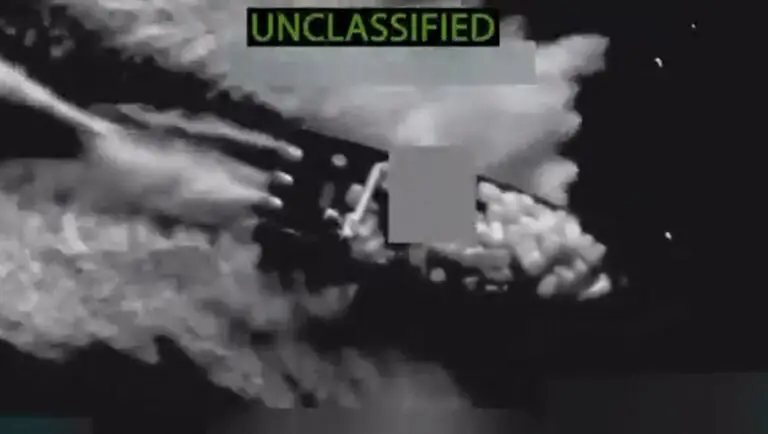
In a move sending shockwaves across Latin America, U.S. military forces have intensified an aggressive and highly controversial anti-narcotics operation in international waters, culminating in the destruction of multiple vessels and the deaths of 14 alleged traffickers in a single day. The operation, carried out in the eastern Pacific, marks the bloodiest escalation yet in a campaign launched last month — one that now accounts for at least 57 lives lost.
Despite the scale and visibility of the strikes, Washington has yet to produce verifiable evidence linking the targeted vessels to active drug trafficking, sparking international backlash and legal scrutiny over the campaign’s legitimacy.
Precision or Provocation?
Defense Secretary Pete Hegseth, in a statement, described the destroyed vessels as part of a known narco-smuggling corridor. He confirmed intelligence had flagged the four boats prior to the strikes and cited “real-time tracking” as justification for the use of lethal force.
Footage released showed high-powered strikes on boats both docked and moving at high speeds — a stark visual of the United States’ increasingly kinetic posture toward maritime trafficking.
The strikes, executed in international waters, also raise questions about sovereignty, due process, and the lack of transparency surrounding the intelligence behind them. Only one individual survived the recent attack; the Pentagon confirmed coordination with Mexican authorities for recovery, though details on the survivor’s condition remain unclear.
Militarizing the Hemisphere
Behind the firepower is a broader, more strategic build-up. The U.S. has deployed seven Navy warships, F-35 fighter jets, and mobilized the USS Gerald R. Ford carrier group to the region. The message: deterrence. The reality: escalation.
Compounding matters is the unpredictable arrival of a major hurricane, forcing U.S. naval assets to pivot rapidly between enforcement and survival.
Meanwhile, the skies near Venezuela have witnessed repeated bomber flyovers — from Cold War-era B-52s to supersonic B-1Bs — stoking accusations from Caracas that Washington is using anti-narcotics enforcement as cover for regime change efforts.
Galapagos and the New Frontlines
Ecuador, a country at the crossroads of international trafficking routes, has emerged as a potential host for a new foreign military installation. President Daniel Noboa, aligning closely with U.S. strategic interests, has signaled openness to establishing a base in the Galapagos Islands — an ecologically and geopolitically sensitive site.
Though no official commitment has been made, the prospect of a foreign military presence in the Pacific archipelago adds a new layer of complexity to an already fraught regional security landscape.
Legal Vacuum, Strategic Intent
The legality of Washington’s campaign remains murky. International law experts argue that even if the targets are proven traffickers, unilateral execution-style strikes in neutral waters — absent judicial oversight — violate multiple conventions.
Yet the U.S. continues undeterred, expanding its operational reach and redefining the rules of engagement in what now appears to be a shadow conflict with no formal declaration of war.
Whether this signals the dawn of a new doctrine — where intelligence justifies assassination and maritime law is rewritten by firepower — remains to be seen.
But one thing is clear: the waves are no longer neutral.
